Carats, Karats, Carets, & Carrots

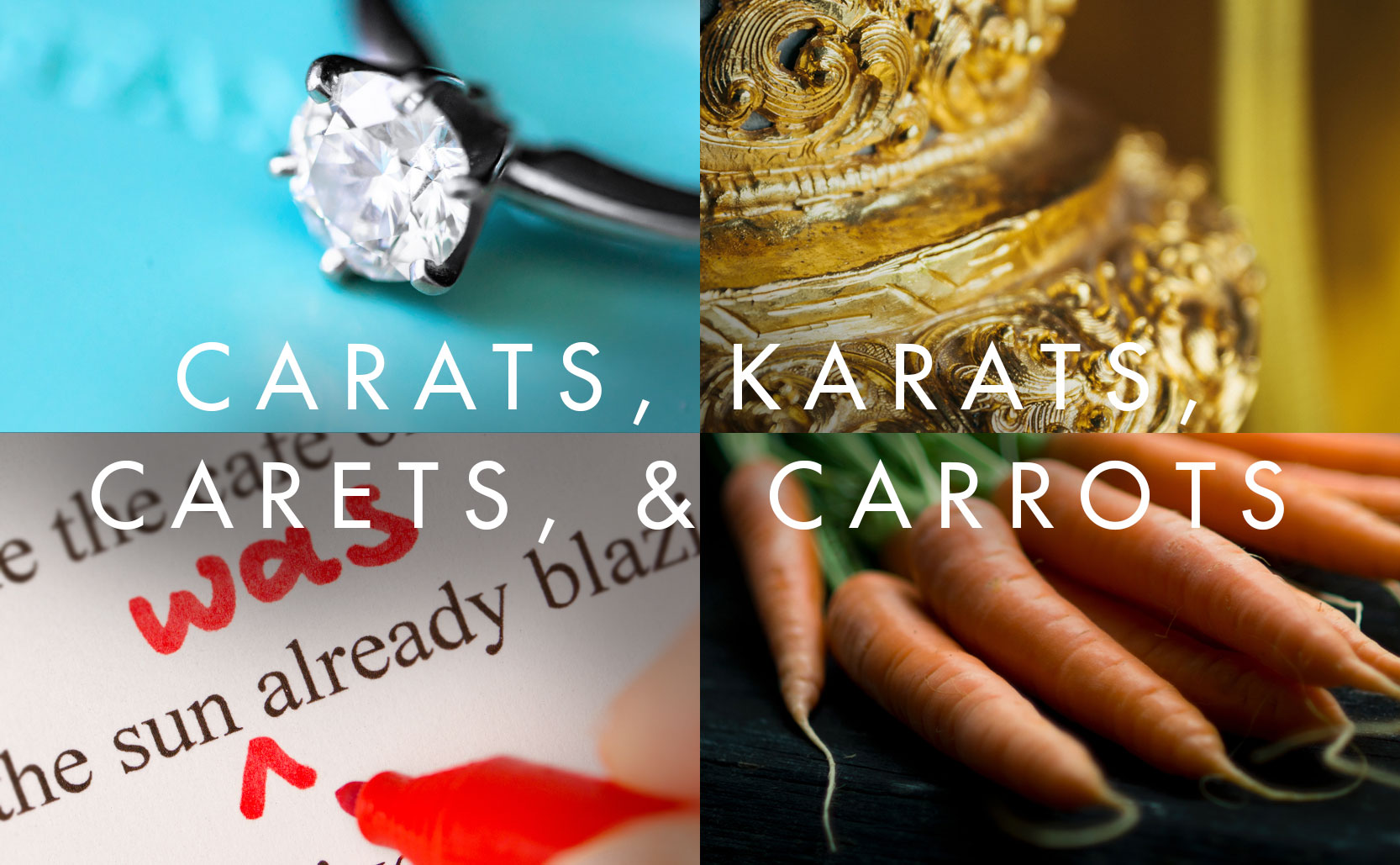
A crash-course on Carats (measures gems & pearls), Karats (measures gold purity), Carets (a symbol), and Carrots (popular with humans & rabbits)

Carat

The carat is a unit of measurement for the mass of gemstones and pearls. Each carat is equal to 200mg of mass. So the more carats, the larger the stone / pearl (basically the more it weighs). The word carat comes from the Italian “carato”, which comes from the Arabic “qirat” which means “fruit of the carob tree” and also “weight of 4 grains”, which also comes from the Greek “keration” for both the carob bean and a small weight.

Karat

Karat with a “k” is a measurement of gold purity. It comes from the same root word as Carat with a “c”, from the Greek “keration”. Gold products are frequently alloys, different blends of gold and one or more other metals. The karat measuring system is a 24 part system and tells you what the ratio is of gold to other metals. So 1 karat gold is 1 part gold mixed with 23 parts other metal(s). Pure gold is 24 karat and contains no other metals.

Interestingly, pure 24 karat gold is fairly soft and not very resilient for jewelry or coins. Silver, copper, and zinc have been popular metals to pair with gold. These other metals strengthen the gold to make it harder. This is not true of lead, which was sometimes used to make fake gold coins. This is where the idea of biting a gold coin comes from. Most real gold coins were hardened alloys and would not leave a tooth mark when bit, but fake gold coins used lead which would be soft and leave a mark.

Caret

A caret is this ^ , which is a typographical mark used by proofreaders to show where something needs to be inserted into an area of text. Caret comes from Latin for “there is lacking” or “it lacks.”

Carrot

Finally, the carrot we are most familiar with is the vegetable, which originated in Persia. Its name also comes from Greek but from “karōtón” meaning horn, since the vegetable has a slightly horn-like shape. Carrots are a healthy vegetable full of beta-Carotene which is a red-orange colored organic pigment. When we eat beta-Carotene it synthesizes into Vitamin A which is good for you (… in moderation). Due to its color, storing extremely excessive amounts of beta-Carotene (eating way too many carrots) has the side-effect of turning a person’s skin orange through stored deposits in the skin cells.

Under normal circumstances however, beta-Carotene is converted into Vitamin A and can give us healthy skin, a better immune system, and good vision. This last part about better vision is the foundation of the myth that British WWII pilots were such good shots because they ate their carrots. In reality, they secretly had on-board radar and didn’t want the Germans to know about it, so they started a propaganda campaign saying their ace shooing was all due to carrots (which the British had an abundance of).
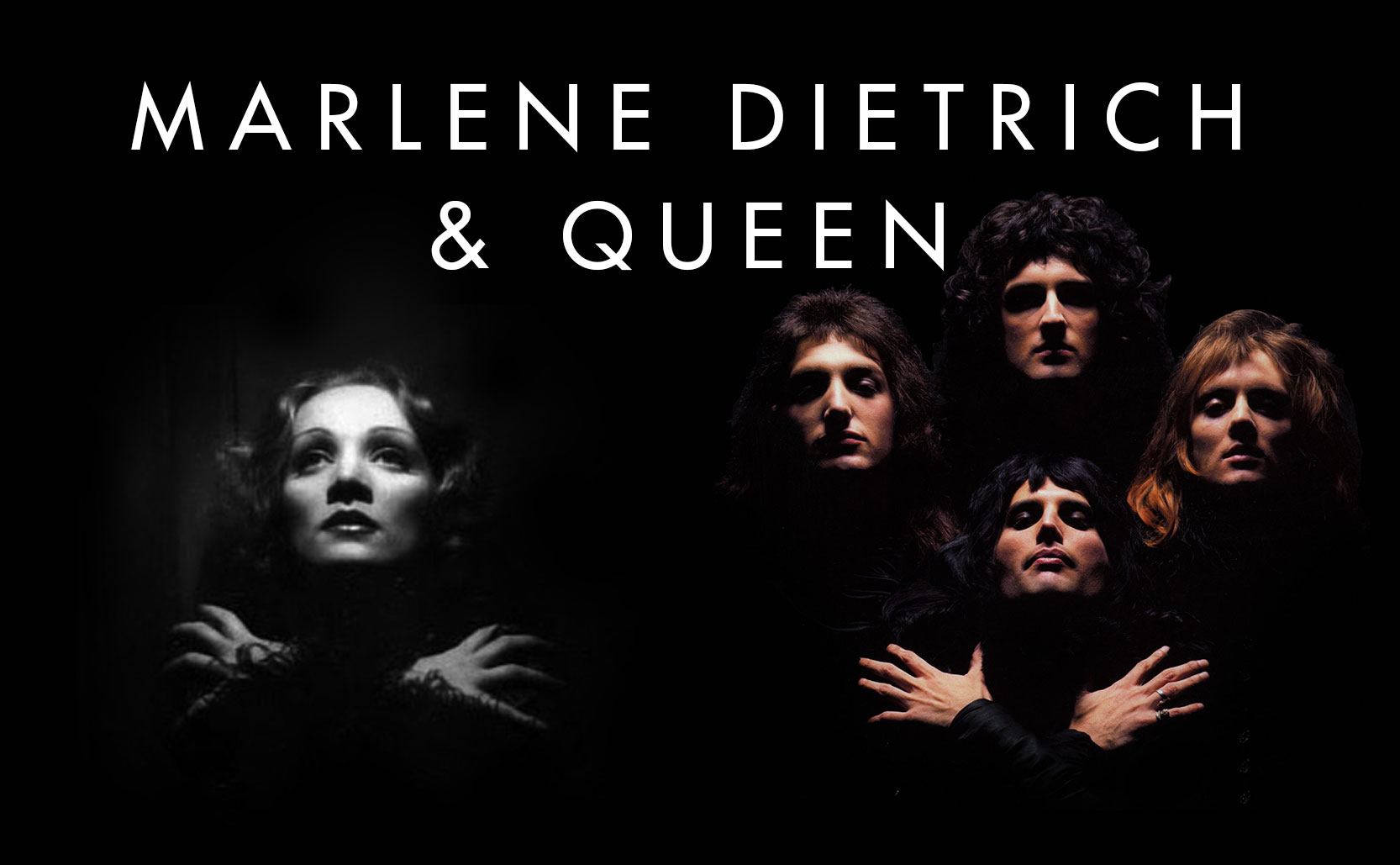
Marlene Dietrich & Queen

One of the most iconic photos of Queen was inspired by a photograph of Marlene Dietrich

For their second album, Queen II, Queen wanted to explore the theme of duality. This was visually explored through black and white imagery and even labeling the two sides of the album Side White and Side Black. They went to photographer Mick Rock (who had worked with David Bowie, Lou Reed, and others in the mid ‘70s glam rock scene) to photograph the album cover.

Rock had recently been shown a 1932 photograph of Marlene Dietrich from the film Shanghai Express. Dietrich was lit with a technique known as “butterfly lighting” where one of the lights is positioned in-front and above the subject, casting shadows down from the subject’s brow, cheeks, and nose (the shadow below the nose produces a butterfly looking image, hence the name). This was a technique frequently used with Dietrich to accentuate her facial features, especially in her collaborations with director Josef von Sternberg.

When Rock showed this photograph to the band, Freddy Mercury loved the idea that they could recreate it for the album cover.

“I don’t know if it was the shot itself or the idea that [Freddie] could be like Marlene Dietrich—probably a combination of the two,”

Mick Rock

This Dietrich inspired pose was used again in the music video for Queen’s greatest masterpiece Bohemian Rhapsody. The video for Bohemian Rhapsody, at over 1 billion views on YouTube, extends Marlene Dietrich’s influence even further, despite some viewers not even knowing it.

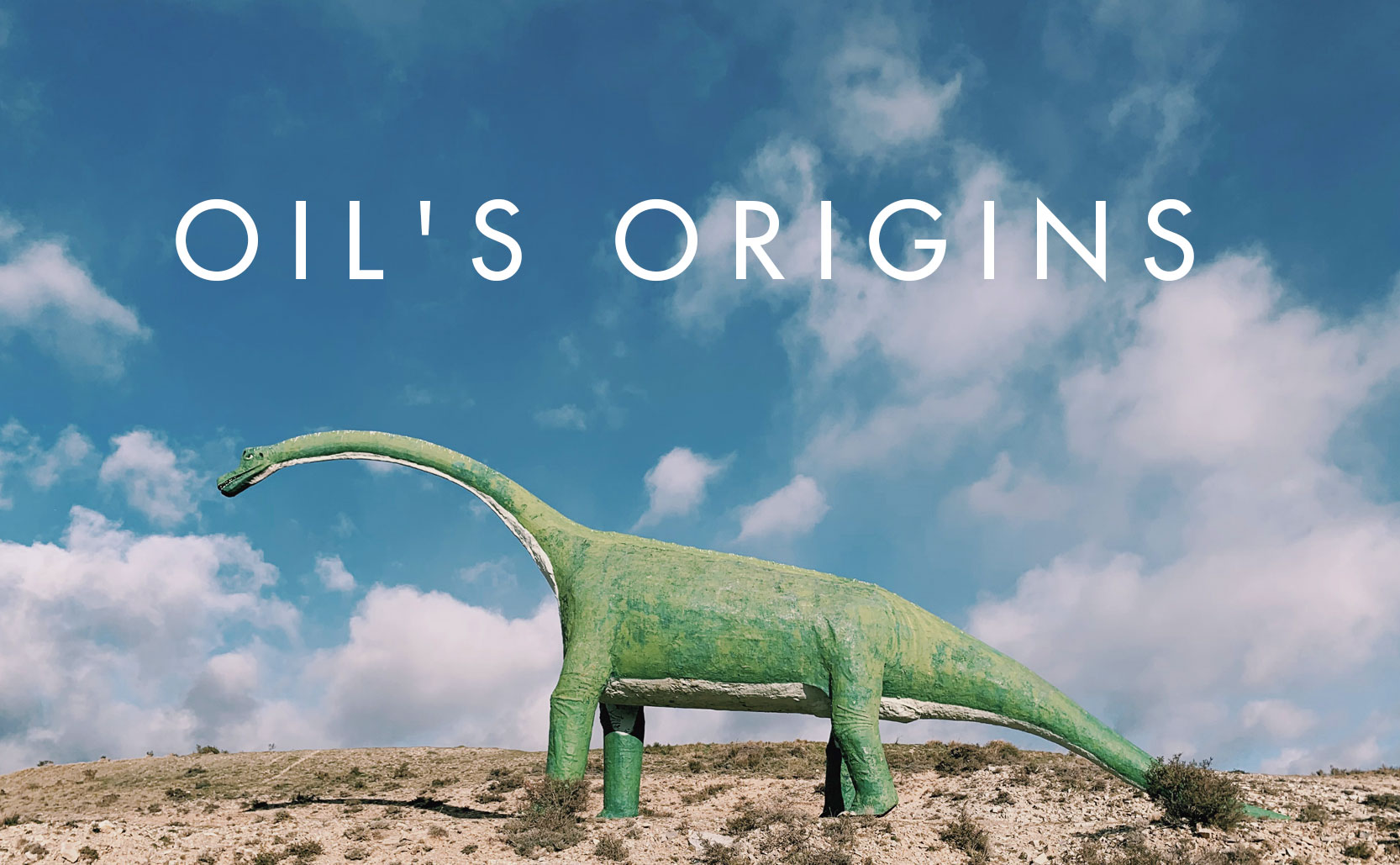
Oil’s Origins

Oil doesn’t come from dinosaurs, it comes from plankton.

When people hear “fossil fuels” they sometimes think that oil (petroleum) came from dinosaur fossils. This isn’t out of left field. At the Chicago World’s Fair of 1933-34 Sinclair Oil sponsored an exhibit that taught people that oil was formed during the time of the dinosaurs. Reinforcing this idea there’s also the logo & mascot for Sinclair Oil, Dino the dinosaur. Sinclair again pushed this connection of dinosaurs & oil at the New York World’s Fair in 1964 even though the science had become pretty clear that oil wasn’t made from dinosaurs. So what makes oil? Plankton.

What are plankton?

Plankton are water dwelling life forms that (more or less) drift with the current. The name “plankton” actually comes from the Greek for “wanderer” or “drifter” which makes them sound like edgy antiheroes in a pulp novel. There are lots of different kinds and sizes of plankton, and they fill all sorts of ecological roles ranging from being food for larger organisms to producing 50% of the Earth’s oxygen. Bacterial plankton formed in the oceans 3 billion years ago and were basically the only form of life until 600 million years ago. That’s an enormous amount of time. So as plankton over that time died, most fell to the bottom of the sea floor and began the process of becoming oil.

Let’s make oil

Lots can happen during hundreds of millions of years. The plankton that fell to the bottom of the oceans continued to accumulate as well as other sediment. The plankton would decompose releasing most of their chemicals but the hydrogen & carbon would remain. This continuous process of plankton and other sediment falling to the ocean floor meant that the former material would be pushed further down and compacted under intense pressure over millions of years, generating heat. It was this pressure and heat that “cooked” all of those plankton into oil.

While it is certainly possible that some dinosaurs may have found themselves a part of this oil making process, it’s just very unlikely they made up much oil – they usually weren’t in the right places and there weren’t enough dinosaurs (not enough raw material to cook with). Instead of being made from some of the Earth’s largest creatures, oil was made from massive amounts of some of the smallest.

8 months of Oysters

Historically it has been safer to eat oysters in the colder months

There is an old adage that you should only eat oysters in months that have the letter “R” in their names. This adage is specifically for the names of months in English and French, and also specifically for the northern hemisphere where these would be the cooler months, September through April.

The reason is simple: before refrigeration oysters would spoil in transit during the warmer summer months (months without an “R” in their names). So, unless you lived near the water with the oysters, there was a greater chance that by the time the oysters got shipped to you they would have spoiled.

Bond … James Bond, ornithologist

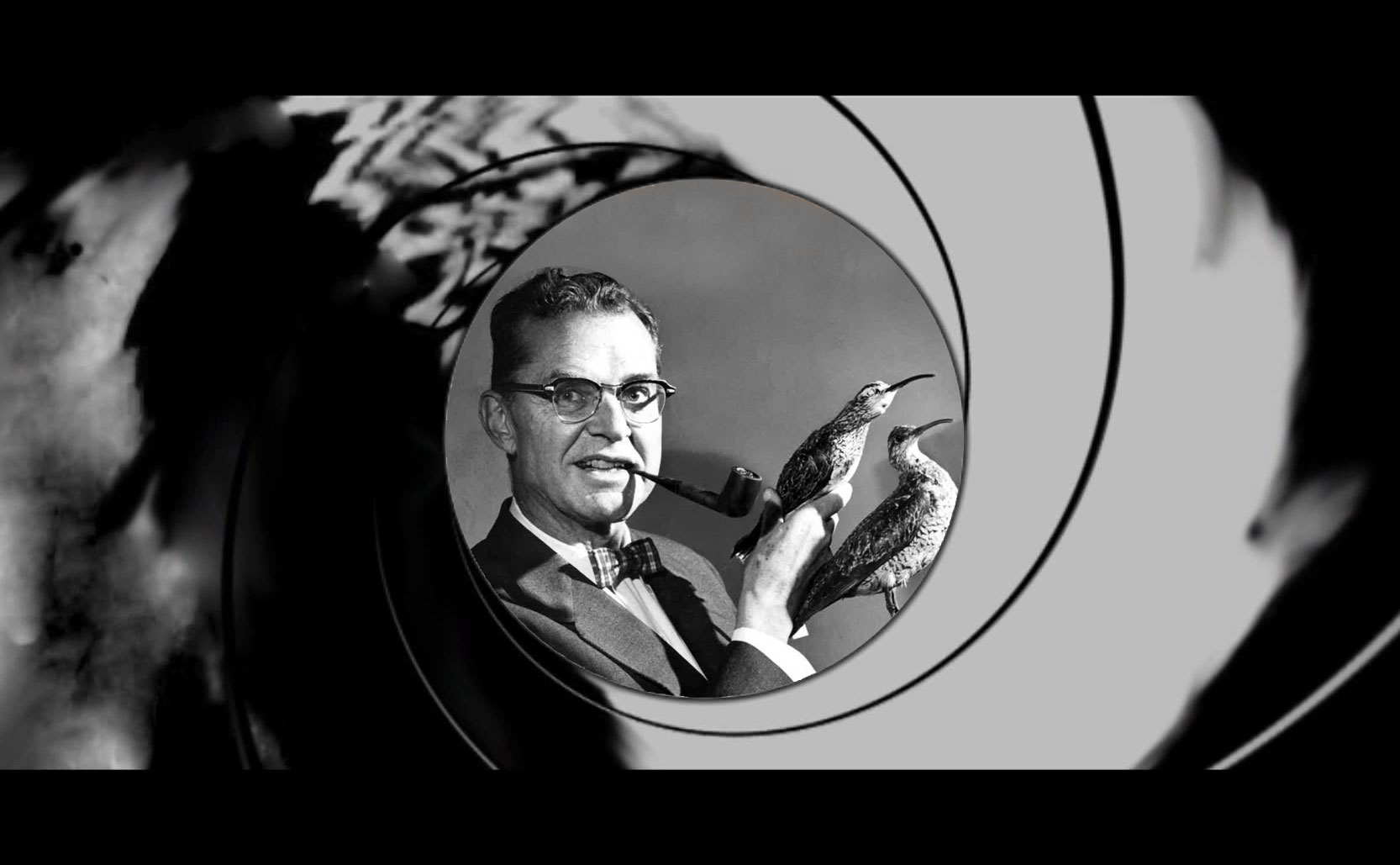
James Bond’s name was taken from a Philadelphia ornithologist

Ian Fleming was living in Jamaica while writing what would become his first James Bond novel, 1953’s Casino Royal. What he needed was a good solid name for his protagonist, a name that very flat and quiet. Fleming was an avid bird watcher and had a copy of Birds of the West Indies by Philadelphia ornithologist James Bond, which he felt would be the perfect name. Fleming later said that:

“I wanted the simplest, dullest, plainest-sounding name I could find, and ‘James Bond’ was much better than something more interesting, like ‘Peregrine Carruthers.’ Exotic things would happen to and around him, but he would be a neutral figure — an anonymous, blunt instrument wielded by a government department.”

The real life James Bond was a celebrated expert in birds of the Caribbean and worked for decades at the Academy of Natural Sciences in Philadelphia. He was unaware of his name’s new found fame until the 007 books became popular in the United States. Bond and his wife paid Fleming an unannounced visit in 1964 while in Jamaica, and presumably things went well because Fleming gave a first edition of You Only Live Twice dedicated to Bond, “To the real James Bond, from the thief of his identity”. In 2008 this dedicated copy sold at auction for $84,000.

Added info: in 2002’s Die Another Day, Bond’s Birds of the West Indies appears in the film being held by, well, Bond, but with the real life author’s name obscured. Pierce Brosnan’s Bond later identifies himself as an ornithologist.

Blue Raspberry

At the confluence of food safety and marketing, blue raspberry was born.

In the natural world, no raspberry looks or tastes anywhere close to “blue raspberry.” The “raspberry” flavor of blue raspberry was created as a combination of banana, cherry, and pineapple. As for its shade of electric blue, most raspberries are red but there are some blue-ish raspberries. The white bark raspberry, native to western North America, is a very dark (nearly black) shade of blue. So why do we have the flavor and color of blue raspberry?

Red Number 2

In the 1950s there was a growing movement in the U.S. to ensure the safety of food and food additives. People had increasing doubts over the safety of Red No 2 (a food dye that, at the time, was made from coal tar). Food companies could capitalize off of this concern if another color was used.

It was during this time that the Gold Medal company of Cincinnati introduced a new flavor of blue raspberry cotton candy. Its popularity took off when Icee introduced their blue raspberry flavored frozen drink in the early 1970s. The competition between blue raspberry and red flavored candies/drinks was taken to a new level in 1976 when Red No 2 was banned in the United States because it was potentially carcinogenic. Simply put, at the time, Blue No 1 was safer than Red No 2.

Marketing

To mimic real life, food companies then and now use the color red for lots of flavors: cherry, apple, cinnamon, watermelon, cranberry, etc. It’s a crowded space. However, there are not many foods that are naturally blue, which as a marketing opportunity was very attractive. Blue was a way to set raspberry apart from the other flavors. This is similar to why pink lemonade exists: lemonade isn’t pink, but pink is a bright color that stands out from the crowd. Blue raspberry had the color all to itself for a long time which was marketing gold.

Dogie, Not Doggy

In American Western slang, a dogie is a calf (not a dog).

The 1937 film Git Along Little Dogies features the singing cowboy, Gene Autry. He and others sing a variety of classic western songs such as Red River Valley, She’ll Be Comin’ Round the Mountain, Oh! Susanna, and others. They even sing some of them as a medley with lyrics on the screen for the audience to sing along.

The movie’s title though, may leave some wondering exactly what a “dogie” is. The movie was named for a song of the same name, which existed as early as 1893. In the American West a dogie is slang for a stray or motherless calf. Nobody is exactly sure where the term came from but in the book Western Words, author Ramon Adams speculates that because small calves who are weened from their mothers too soon are unable to properly digest coarse grass, the resulting swelling of their bellies resembled a batch of sourdough starter in a sack. This became “dough-guts” and eventually just “dogies.”

The Chuck Yeager pilot voice

Airline pilots tend to talk the same because they’re all emulating Chuck Yeager.

In Tom Wolfe’s 1979 book The Right Stuff, he credits the calm … folksy … drawn out, matter-of-fact way that airline pilots tend to speak, to the world famous decorated American pilot Chuck Yeager.

Yeager grew up in West Virginia and entered the military in 1941. During WWII he went from being a mechanic to a decorated fighter pilot in just a few years. It was after the war however that he achieved the feat that made him a legend. On October 14, 1947 as a test pilot he flew the experimental plane Bell X-1 at Mach 1 and became the first human to break the sound barrier, the first to fly faster than the speed of sound. Also worth noting, he broke the sound barrier while flying with two broken ribs from a horse riding accident just a few days prior (which he “forgot” to report to his superiors).

It was because of his exploits as a pilot, and his generally cool demeanor, that led other pilots to want to be like him. His relatively neutral American accent and his vocal mannerisms soon became emulated by other military pilots. Then other pilots copied those pilots, military pilots become civilian commercial pilots, and so on.

Orange the fruit, orange the color

Orange the color was named for orange the fruit, not the other way around.

The English word for the color orange has a trail back through a few European languages with its origins in the Sanskrit “nāraṅga” which was the name for the orange tree. Oranges the fruit came to Europe through Spain with the Moors, who in Arabic called the fruit “nāranj”.

“Nāranj” became “narange” in English during the 14th century and by the early 16th century the spelling became “orange.” The word “orange” was then used to describe things that were the color of the fruit.

Some confusion may apply

Without a name for a color, cultures use the words they have to describe the things around them. Because English didn’t have a word for the color orange until the 16th century, some things that are orange (or orange-ish) were labeled as red because it was the closest color that English had a word for. “Red” hair and the robin “redbreast” for example are really more orange than red, but they were named before English had the word “orange”.

Describing the colors of things before a language has names for those colors had been a problem across cultures for a long time. The Ancient Greeks had a very limited palette of color names to choose from. For example, there seems to have been no word in Ancient Greek for the color “blue” so in Homer’s The Iliad and The Odyssey he describes both the sky and the sea as being a wine / bronze color. Even stranger, he also describes sheep as being wine colored.

Rosanna Arquette’s Two Pop Hits

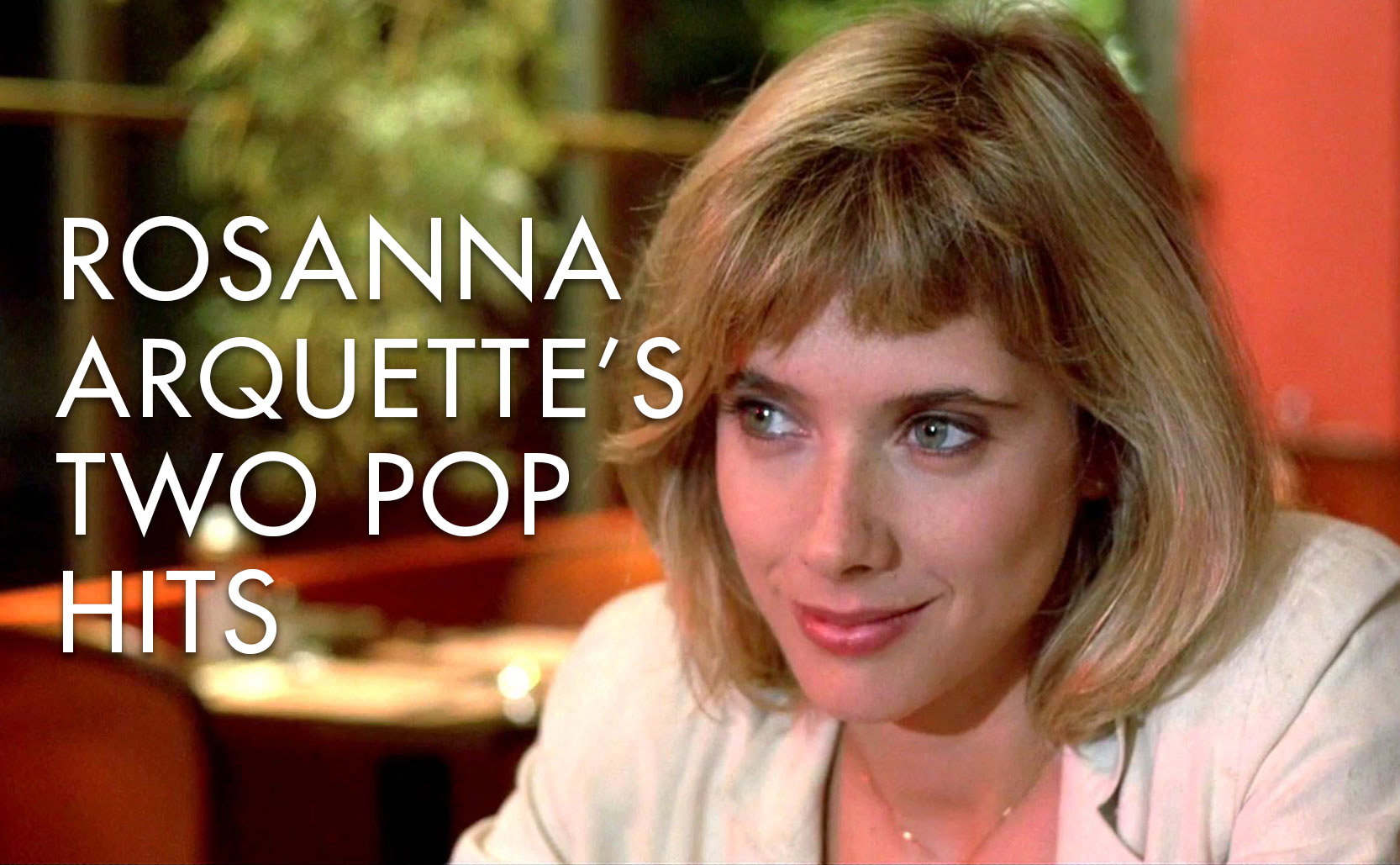
The award winning actress Rosanna Arquette is said to have been the inspiration for more than one hit song of the 1980s.

Rosanna

A bit on the nose, 1982’s Rosanna by Toto was written while Arquette was dating Toto keyboardist Steve Porcaro. While the name of the song was taken from Arquette, the lyrics are about a mixture of people and not specifically about Rosanna Arquette.

The video, which is fantastically very ‘80s, has a then unknown Patrick Swayze and Cynthia Rhodes as dancers, both of whom went on to be in 1987’s Dirty Dancing.

Toto’s 1982 hit Rosanna was named for Rosanna Arquette.

In Your Eyes and Say Anything

Arquette is also said to have been the inspiration for the even bigger hit 1986’s In Your Eyes by Peter Gabriel. Arquette was dating Gabriel at the time and was not only the inspiration for the song but also encouraged Gabriel to let Cameron Crowe use the song in 1989’s Say Anything … .

In Say Anything … the song is used in the most iconic moment of the film (and one of the most memorable scenes in cinema) where, like a 1980s Romeo & Juliet, John Cusack’s character holds his boombox over his head below the bedroom window of Ione Skye’s character.

Peter Gabriel’s smash hit In Your Eyes, while not named for Arquette, is about her.